Monday, April 6, 2020

NAPOWRIMO # 6 Ekphrasis and the Garden of Earthly Delights.

Aleyt Considers all the earthly delights


My friends ask me, Aleyt they’ll say, “What’s that
wacky husband of yours painting today?”
I usually shrug and pour them drinks. Its best to
appear indifferent.

I go out to the studio early
in the morning before he’s up.
(He stays up late you know, painting
and drinking.  He’ll end by washing
his brushes and having his town friends in.)

They leave behind a mess of paint
and tobacco and food. They piss in cups.
The place stinks like semen and old ale.
I breathe it.

I roam about his studio with its view of the hills.
I watch the mist laze over the fields, and I wonder
about this man I’ve married. Mama told me it was
a mistake, but I was seduced by art,
whatever that means.

Look there is a song tattooed on a man’s buttocks.

Men riding birds and women eating
cherries out of eggshells. Pink fairy buildings
and exotic animals. He’s started on
this next part.  Dark he tells me.
It’s about hell and the evils that await man.  

He’s sleeping there, slumped in a pile
over some rags and drop cloths,
snoring over the birdsong of early morning.
I take one of his brushes, dip it in some paint,
still wet from the day before, and drag
it slowly across his upper lip.

He rubs his face and rolls over.  Is that me,
I wonder?  Peering into the painting, as I consider 
a naked woman in the foreground holding a fish…her hair looks
exactly like mine.


Saturday, October 3, 2015

Big Magic: Creative Living Beyond Fear by Elizabeth Gilbert

27. A Book with Magic

When I read books written by Elizabeth Gilbert, I feel like I am reading in big great gulps. She is so fun and easy to read. Everything written by her goes quickly.  What is it about her writing that makes her so readable?  I believe that is what made her big best seller Eat Pray Love so successful. The journey could have been anyones.  The insights were good but truthfully the woman knows how to write clearly, cogently and compellingly.  I had read one of her earlier books called The Last American Man long before Eat Pray Love came out and she was readable then too.  Her novel, Signature of All Things--fastest 700 pages I have ever read.  Beautiful, well told story. How does she do it? I would love to write so well that time slips away as you turn the pages.

I didn't even know she had a new book out, except suddenly there she was in my FB feed thanking me for being so supportive of her new book, so I ran out and bought a copy of Big Magic.  It is about creativity and how to embrace it and use it and be in it and be your best artistic self.

Big Magic is an artistic memoir.  It answers the question: How did Elizabeth Gilbert get to be a writer?  What does she think has made her so successful?   Again, I read this quickly and in great mouthfuls--good stories, good lessons--100% Liz Gilbert.  She believes that you should be an artist and creative person before you worry about being successful.  Don't worry so much about making it your living, make it simply your life. Her lessons revolve around several main topics: courage, enchantment, permission, trust, and persistence. All with examples from her own life and her artistic friends' lives.

I have heard her speak before and some of what she speaks about is recounted in this book.  Good life lessons, all of it.  I would use this when I teach or write, to give myself and others inspiration or direction. It is nothing remarkably new or groundbreaking, but it is well written and very much all about Ms Gilbert and her creative life. All worth reading.  It is very fast--a good library read.  Or you can borrow it from me!

Monday, September 28, 2015

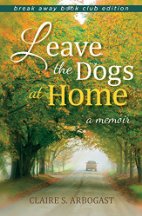
Leave the Dogs at Home by Claire S Arbogast

25. & 26.  A book set in a high school and a book in my hometown.

The summer has come and gone and as usual I lost a lot of my interest in reading as the sun shone brightly and beckoned me to other pursuits. I may not finish this challenge by years end but it has been interesting for me.

The book set in a high school is only mentioned as it is a manuscript that someone has trusted me to read before it was published.  I loved reading it, but am not at liberty to review it because it still belongs to the heart and mind of the writer, but I make note of its presence in my reading life. It is always a good and fine thing to put your stuff out there. Risky and human and beautiful.  I admire any writer who does that.

The book set in my hometown was  somewhat trickier for me to find and write about.  My true home town is a suburb east of Cleveland, Ohio.  A good place to grow up but not particularly noteworthy for literary achievements although the 20th president of the US is from there and I used to work as a tour guide at his house. This is probably the subject of another blog.

Instead, I choose my hometown to be the place I live now and have lived for 22 years: Bloomington, Indiana.  I have lived here longer than the place I grew up, so we are calling this my home town and here is a memoir by a fellow writer that was published in the thick of this fallow reading summer and has inspired me to be creative and live that life I want to live.  Ms Arbogast's memoir is set in my hometown and takes place in and around the IU campus where I work and where my husband and I have gotten 3 degrees between us.

Here is a story of a woman coming to terms with her husband and partner's death.  It is moving and poignant and filled with life. I am glad to know the writer and know the town it was set in.  The title is perfect.

So this entry is dedicated to the writers I know. The writer in me and the writer in you.  Go forth and create!

Sunday, August 2, 2015

What Comes Next and How to Like it by Abigail Thomas

24. A book with a love triangle

Abigail Thomas is possibly the freshest, wittiest, easiest to read, loveliest, most honest, most authentic writer on the planet and she has a new book out! I loved A Three Dog Life  and  Safekeeping.  She has a wonderful small book about writing memoir that I use when I teach memoir. She is a perfect read for any occasion.  They should make a movie of her sweet life as revealed in all her memoir. I think she made memoir a genre--not sure about that though.

Anyway, Ms. Thomas is aging and contemplating the things one contemplates at the end of life among them a long friendship that spans the decades and includes a kind of infidelity, her own children and her love of them, he daughters cancer diagnosis, and her own mortality. Ms. Thomas is observant, witty, and can create tension in the narrative over the most normal life events.  The book was pure pleasure on every page.

Enjoyable!

Sunday, July 26, 2015

Redeployment by Phil Klay


23. A Book of Short Stories

Redeployment by Phil Klay won the National Book Award.  The description, a book of stories about soldiers at war in Iraq in the post 9/11 era, caught my attention because I absolutely loved Tim O'Brien's book of short stories called The Things They Carried, short stories about soldiers in the Viet Nam war. I will never know war first hand (at least I hope never to) and am interested in the stories war brings to the table. 

As one would expect the stories are full of irony, horror and hypocrisy. They are full of truth and beauty and terribly compelling. Heres a story about a chaplain trying to help men he ministers to be more compassionate. Heres a marine in a bar with his disfigured friend meeting beautiful women. Heres a story told all in military acryonyms.  Heres a story about a man who comes to lead an NGO to do good works in a horrible place and finds that the best thing he can do is stage a photo of some boys playing baseball.  

All told in first person, by male narrators, some long, some short, some stateside, some in Iraq, all worthy of attention.  This is a fine collection.  I enjoyed it.

Monday, July 20, 2015

Bettyville by George Hodgeman

22. A book based on or turned into a TV show


From the dedication page:  "Finally it is for Madison and Paris, where so many I have cared about walked. I will always remember you, good people."

Epigraph from the book: If only one knew what to remember or pretend to remember. Make a decision and what you want from the lost things will present itself. You can take it down like a can from a shelf. ~Elizabeth Hardwick, Sleepless Nights.


Love for this story and this book and this writer took me by surprise. I spent the first 75 or 100 pages trying to decide what the writer was trying to do and when I finally got it, I was in love.

George Hodgman has written a beautiful memoir about growing up in Paris, Missouri and taking care of his aging mother Betty in the present day. It is an elegy to small town rural life that is disappearing under a haze of poverty and meth clinics; it is a love letter to his mother; it is a painful understanding of what it means to be young and gay and come out to your parents. It is the bittersweet time of life when you are saying farewell to the people who knew you best and are taking stock of what they have given you and what you in turn have made of it.

Page by page Mr Hodgeman won me over with beautiful writing, love for his home and his people, and a slow building of suspense for how everything would turn out with his mother and his life.  Let me add also that the author is hysterically funny. He has a dry with that allows him to slip in great lines and passages again and again.

This is an amazing book made great because Mr Hodgman is a really truly fine writer.  Betty and George could be any one of us.  Betty and George didn't fly to the moon or get elected president. What they did was not extraordinary, but the author's writing is simply superb. So many lines to write down, so many places to stop and hold your breath because he knows exactly how to express love and family and emotion and life.  I truly can't say enough great about this memoir.

This is a book I will gift to many people as we all come to understand what it means to grow old and say good-bye to our past and make sense of how we became who we became.

( I read somewhere that this books has been optioned for a TV series--not sure if i will come about but I think that qualifies it for the above category!)

Sunday, July 12, 2015

The Light Between the Oceans by ML Stedman

21.  A Book That Became a Movie

My summer beach read is set in 1920's Australia--on an island called Janus where the lighthouse keeper and his wife live in isolation from the rest of the world.  Tom is a decorated war hero and Isabel is his young bride.  Both are excited about the prospect of having children but when Izzy has miscarriage after miscarriage she begins to go a little mad.  A storm one day brings in a small rowboat with a dead man holding a little crying baby.  Izzy and Tom see it as a gift from God and they raise the baby as their own. Until one day they just cannot escape the truth any longer. They must confess and deliver the child to her true mother.

This is a page turner and a tear jerker all in one book.  I sobbed pretty well through the last few chapters. It was a beautiful story, a tad overwrought in places, and I think the author wrote it to be turned into a movie because there were definitely some cinematic scenes--many of them--and the location of the novel-a distant lighthouse in the sea are also very cinematic. There are also a lot of twists and turns--I really did not guess how it would end.  So its really a fine read.

As a writer, I noticed how deftly she wove points of view back and forth between multiple characters. I loved that about the book.  I personally always have a hard time reading about sad things happening to good people--but hey--thats the point of a good story.

So this is worth picking up.  Good beach read.

(After writing this review, I went back to note that someone has made this into a movie set to be released this year.  When I started the review I had not done that homework.  Cant wait to see the movie now.)


Thursday, July 2, 2015

When Women were Birds: 54 Variations on Voice by Terry Tempest Williams

20. A Book with a Number in the Title

 Terry Tempest William's mother died when she was 54. She told Terry that when she died, Terry would get all her journals. Terry's mother kept years and years worth of journals. When Terry opened them up after she had died all she found were blank pages. Book after book, year after year, white page after white page, nothing but blank white pages.

 Terry uses this fact quite brilliantly as a metaphor for her mothers voice and in fact women's voices everywhere. She tells 54 tales of voice, 54 ways to ponder her mother's enigmatic journal. There were tales of being frightened by creepy men in the wilderness and never telling anyone. Tales of testifying before congress. Tales of her mother's journey, of meeting her husband. All ways of looking at our voice both realistically and metaphorically.

 This book had an ethereal zen like quality. You could read it again and again and find new lessons every time. Lots of prompts for writers. Lots of things to ponder for women and members of the human race. I loved it. It makes me want to write another variation on voice.

Tuesday, June 16, 2015

The Public Library: A photo essay by Robert Dawson


Imagine a road trip or two where you drive the US in search of libraries old and new to photograph.Mr. Dawson has spent the past 20 years or so romancing the public library.  There is no greater institution in a democracy than a library. The book is filled with photos and wonderment about the bastion of free books, ideas and knowledge.  This is a lovely book to love.  


It is sprinkled with essays by famous writers and not so famous librarians about the role of the library and the experiences of the librarian that are also worth the read.  My favorite was the cogent discussion of the library's role in the social service network.  What is a librarian to do about all those vagrants and crazy people that haunt the library?  

I loaned this to my mother who enjoyed the photos as well. She commented that when we were in elementary school back in the 70s they made a big push to call the library "the media center". At the time I didn't think anything about it, but I realize now that I didn't like that too much.  Of course, much of this book is dedicated to the erosion of public libraries in our current culture: the cuts to finding, the decay of infrastructure, the belief that the internet makes books obsolete.  Perhaps if we did call them media centers people would rush to them. Surprised perhaps that the first media--the original media--had little to do with bytes and charging stations and much to do with print and type bound between two boards.

The best part of this road trip and photo essay book was that it was a father and son road trip.  What a marvelous way to share your love with your child.  If you love libraries, go buy this.  

Sunday, May 17, 2015

Between You and Me: Confessions of a Comma Queen by Mary Norris

18.  A book published this year

This book came onto my radar when the author published a short article about her 30 year career as a copy editor at the New Yorker. The article was so charming that I requested her book from the library before it was even out.  By the time I got to the queue there were already 3 people on it.

This is such a charming book, I don't know where to begin with my praise: her explanation of her job as a copy editor at one of the most prestigious and highly regarded magazines in history replete with anecdotes about authors, and how customs came to be, and how she views various punctuation conundrums; her story about finding her first major error (flour instead of flower) just before the magazine went to press and getting thanks and praise for it and taking herself out for a beer to celebrate; the story of which dictionaries they use and why; or her love of a good pencil, and eraser and pencil sharpener. The epilogue is especially poignant.

This book is a word lover and readers delight.  I smiled throughout, laughed audibly multiple times and read many passages aloud to my husband who is a language and word maven.  Yes, there are times when her discussion of the use of the dash got a little too detailed for me, but those small parts paled in comparison to the whole book which was a fascinating discussion of writing, usage, the great New Yorker magazine and the evolution of language in all its beauty.  

It made me smile thinking of all my editor friends who spend a great deal of time, as Ms Norris does, mulling over the proper placement of dashes and commas and semi-colons.  Auto-correct be damned!

You already know if you are word maven enough to enjoy this book.  Check it out.  (Ann Hicks, if you read this, I think you will love it.)

Saturday, May 2, 2015

The Dream Lover by Elizabeth Berg

17. A Book Set in Another Country

In a facebook post, author Elizabeth Berg told a story about her coming novel, a work of historical fiction about 19th century writer George Sand. She said that she had read about George Sand's life, she was fascinated, and implored a writer friend who wrote historical fiction to write a novel based on the life of George Sand. The friend said, "It sounds like your book, you write it." So she did.

So when the book when it came out a few weeks ago, I bought a birthday present for myself. I was interested in the writing process.  How does a writer study history and then fill in the gaps to create a work of fiction?  I felt that this novel would teach me something about writing and about history.

George Sand was a pseudonym for Aurore Dupin a 19th century French writer and bon vivant living and writing in Paris and the French country town of Nohant where her family home was located. Aurore took the name and began dressing in men's clothes when she understood that she could get cheap seats at the theater as a man. She found she liked the freedom men's clothing and masquerading as a man could give her. George Sand kept company with all the famous writers and artists of the day: Chopin, Liszt, Dellacroix, Balzac and Flaubert. She desired to live a life on her own terms and was probably as famous for that as she was for her many many novels, articles and plays.

Berg painted an impressionistic portrait of George Sand from her birth and the origins of her family through to her death. We come to know her complex feelings about her mother, her grandmother, her children and her chosen life as an artist and lover to many of the artists of the day. I was immersed in a French artists life for the week it took me to read it.  I dreamed of Paris and the seine and laughing around a table of french artists.  It made me want to go to Paris.

I was amazed again and again at how progressive and modern this woman seemed. In fact, I kept wondering how Berg might have made the reader more aware of how unusual Sand was for her gender and during the time. She seemed to be perfectly normal in the context of the book, yet she was so different than other women. This perhaps was my main criticism of the book. How can it be made clearer what an unusual person this was? Or perhaps she was not.

This all was such a stunning stunning portrait of a life and a time.  I felt like Ms Berg did a tremendous job at recreating Sands life. I kept reading her prose and wondering how easy or hard it was to turn this real life into the portrait on paper that I experienced. I am looking forward to reading her earlier novels.


Thursday, April 23, 2015

The Girl on the Train by Paula Hawkins

16. A Thriller

This seems to be the it book of the season thus far: featured at B & N and a long wait at the library. A young woman, Rachel, rides the train every day. Rachel observes the same couple in the same house and concocts an idyllic story of their life together as her train rumbles by. Watching them consumes her. It is probably no coincidence that her former house is just 4 houses away, and she also watches it with longing and jealousy. Her former husband and his new wife and baby live there.

Slowly we realize that he left her because she was a sloppy angry drunk. She has lost her job and has no money and lives with a flat mate and gets drunk day after day.  It is through this drunken haze of self pity and loathing that she sees something unusual at the flat she has been watching.  She goes to check it out, and of course she is embroiled in a mystery. The wife is missing. Her ex and his new wife down the block hate her being around and create the perfect love triangle to keep the plot twisting.

It is a fascinating study of memory and loss and point of view.  Ms Hawkins debut novel is not only a compelling read, a thoughtful page turner, but it is a great twist on the genre.  The hero is likable and very fallible and it is great to see a female character in the role of drunken hero.  We hate her; we love her; we root for her.  Put yourself in the library queue, I guarantee your book group is going to read The Girl on the Train.


Friday, April 17, 2015

Mean Little Deaf Queer: A Memoir by Terry Galloway

15. A Memoir

Following the recommendation of a reader on FB--I picked up this memoir at the library. Here is one of the thirst things that caught my eye:

"I feel intensely fond of the whole lot of lousy writing [memoir] that has found its way to print because I smell in those stinkers a fecund democracy. Every sort of half coherent loser is having his say. Maybe even mean little deaf queers like me."

So why do we like memoir so much?  I think that Galloway spells it out quite nicely. It is democratic. We let people any people tell their stories. Perhaps, some of them, might not be well told, but let people tell anyway. It is good for us.

The title pretty much spells out the book for you. She is deaf (from age 9) , gay and has a bit of an attitude. Her chosen profession is acting and she is from Texas. She is happily married to a wonderful woman and coming out was not a huge tragedy, but rather her parents loved and accepted her for who she was.

The memoir itself was well written.  There were many places in the narrative that took my breath away and a few not so much, but I loved understanding what life was like for someone deaf in the 60s and 70s.  The bulky non-working hearing aids and the inability to use a phone.  Also, what it was like for a deaf actor to find work and respect. All of it compelling.

I never really understood what the central tension of the memoir was supposed to be.  What did our hero need to resolve? Was it acceptance of her sexuality?  disability?  Her unusual career?  Ms Galloway came to find a niche for herself in disability theater. Her big aha momnet was not so much accepting that she was disabled but that her disability could lead her to performing with others who were disabled.  That the disabled deserved a place on the stage. The best scene in the book was when she was assigned (without being asked or knowing what she was doing) to a group of disabled people and told to do a performance workshop with them. She founded VSA the Texas Arts and Disability Organization.

Her conclusion is like mine--everyone has a story and everyone deserves the right to tell it and be heard. She concludes by telling some stories of her fellow disabled actors.

The epilogue is where she speaks most profoundly about sound and hearing.  She is given some digital hearing aids which vastly  improve the quality of her hearing. She describes the sudden onslaught of every day noises poetically. It made me yearn for the sound of my lawn mower. She writes "...from the day I realized I was going deaf, sound was my lost love."

And so it is a memoir to the absence of sound, the lost love,  and to all who lost their loves.  This is a worthy memoir.  Maybe not such bad writing but definitely one that belongs in the democracy of the stories.


Wednesday, April 8, 2015

All the Bright Places by Jennifer Niven

14.  A book you choose for the cover

Its just sitting there, propped up on every spare surface in Barnes and Nobles. It is a hardback book--always out of my price range. I notice it.  The next time I pick it up and look at it more closely. The cover is lavendar and one of the characters is named Violet. I could lick it.  I put it down.  It is a Young Adult (YA) book, a genre which until recently I have disregarded, but hey, those kids sometimes are interesting.  I used to be a kid. So why is B & N pushing this book so hard?

The thing I love about young adult books is no matter what the book or the subject matter, they are instantly relatable. High school is high school whether you went through it in the 70's or now. Teens are teens and the adults who try to deal with the teens haven't much changed. Well, there's screens now and texting, but it all pretty much works the same way.

This book is about the worst of the worst teen dramas: bullying, accidental death, and suicide. It is also a love story about two memorable characters Violet and Finch. The bonus in this read (and probably why Barnes and Nobles has this so prominently featured) is it takes place in my lovely state of Indiana. It features real cities and places and teen hang outs and all the kids are going to IU when they graduate. This is a story also about place. At first, I thought the author was making stuff up about Indiana--but they were real places and the author, Jennifer Niven, grew up in Indiana.

I recently learned that in the world of classifying books for publishers and bookstores that the reason a book is slotted into the YA genre is that the protagonist is a young adult him or herself. I wonder if that classification keeps people from crossing over?  Well, I'm glad I took a gamble on the lavender cover with the post-it notes. I enjoyed this book. I cared about the characters and enjoyed a unique window into modern high school life. I also appreciated that the book was not predictable. I kept expecting certain scenes to happen that did not so double bonus.  Young adult or not, I think there is something for everyone in here. I waited for this from the library for a long time so I know there are lots people clamoring to read it.  Perhaps other crossovers like me.

Tuesday, March 31, 2015

Wave by Sonali Deraniyagala

13.  A book with a one word title

A friend highly recommended Wave and loaned it to me. I warily eyed it on my desk for weeks.  I knew what it was about, and I wasn't sure if I could handle it. The author's personal account of the Indian Ocean Tsunami that struck Indonesia and Sri Lanka the day after Christmas in 2004.  The author and her family were vacationing at the beach when the tidal wave struck. It killed the author's husband, young children, and parents along with close to 250,000 other people.

This is a memoir of unspeakable grief. I found myself bursting into tears again and again. How could a mother live after her whole family is senselessly killed?  How do you even begin to make sense of life after such horrifying loss?

I believe this could be a bible for someone who has gone through loss and is experiencing grief. I can really relate to the idea that grief is such a personal experience and no two people grieve the same way.  Certainly Sonali's grief is deep and profound and in her memoir we see how unique it is compared to others. Initially she strives to disconnect from her memory and it is only when she allows it in that she begins to function.

I kept expecting her to meet a wonderful man and fall in love again and begin to build her life, but the book simply ended with 7 years passage of time and the brief realization that every day heals her a bit but she will never fully be healed. I was really taken with the notion that she never tells anyone her story.  That when she meets strangers on planes who ask her about family she tells them she has none. To tell strangers the truth of her grief is too great a burden to put on anyone. She recoils at the thought of sharing that part of her.  When I think about that magnitude of loss, I wonder too, if I wouldn't make the same choice.

This is a three hanky book, a fast read, but you'll need to stop and dry your eyes many times.  I highly recommend it, but only if you can wade into grief that is terribly deep and wide.  I can't be certain yet but I think somehow this book has changed me.

Wednesday, March 25, 2015

100 Demons by Lynda Barry

12. Graphic Novel

The Graphic Novel. The pop sugar list had a graphic novel on it. I was dreading this part of the reading year. I don't generally read or like graphic novels.  Oh wait, there was a brilliant one I read last year by Roz Chast called Can't We Talk About Something More Pleasant?  about her parents aging and eventual residence in a nursing home. It was a heartbreaking, witty, memoir that resonated with a lot of what weighs heavily on my mind--end of life care and compassion.

So yesterday, I was thinking where oh where could I find a lovely book like that. I was dreading going to the teen boy section at the library, figuring that was where all the graphic novels were located. They are all about vampires and zombies and Thor, and I think there is a famous one about the Holocaust.  So in my wildly prejudicial mind I was convinced that they were all for teenagers except that one by Roz Chast mentioned above.  I was in a snit.  Ugh!  Then it dawned on me that not only were there lots of other graphic novels for middle aged women, but I might actually own a few.

Guess what!?  I do own some.  Books by the ever beautiful cartoonist and humorist and memoirist Lynda Barry and Alison (MacArthur Genius Grant Winner) Bechdel. They've been on my shelf for a few years, untouched.  I pulled 100 Demons off the shelf and read it last night.

I had read Lynda Barry's comic strips in the Chicago Reader back when I was in college. She is a peer of Matt Groening of Simpson's fame who also came to fame in the LA Reader for his comic Love is Hell.

Ms Barry calls One Hundred Demons her autobifictionalography. Some is true; some is made up. I think this is probably true of all good writing.

The author recalls in drawing form how she came across a book from the zen masters called 100 Demons and in it the masters instruct you to draw the demon when it  comes out of your head and thereby conquer it.  She proceeds to sketch and tell the stories of her demons, mostly from her self-described awkward childhood: head lice, bad boyfriends, smells, dancing, regrets, her first job, cicadas, and much more.  The writing and stories and pictures are really powerful. I cannot pick a favorite, but it would be fun to do some writing about my own 100 demons.  She invited readers to pick up pen and ink and do the same. Me an artist?!  I just have never considered it.  But it is a compelling idea.

So I can check off Graphic Novel and I am so much the richer person for it.


Saturday, March 21, 2015

Elephant Company by Vicki Croke

11.  A Book with Non-Human Characters 

I was led to this because I need to get back to my book club, so that I can request a book for us to read together and discuss.  I do love this bookclub and have not been reading and attending.  I'd better get going. So the next book club selection was this book about elephants.  ELEPHANTS!  I am not a huge animal fiend.  Then again, every time I pick up a book about a human who loves animals, I am usually quite taken by it.  Interesting people like animals.  Interesting people dedicate their lives to loving and understanding animals.  Maybe this would not be so bad.  I've also been on a World War II reading kick over the past few months.

Elephant company truly did not disappoint me. James "Elephant Bill" Williams fought in WWI and discovered a love for camels which he rode in the war.  In choosing post war employment he decided his love was for animals and chose to move to Burma and work with elephants at the Bombay Burma Teak Company.  He spent the next 20 plus years learning about elephants, working with them in the jungle, raising a family in the jungle and when war broke out again, using the elephants to lead people to safety from the Japanese and building bridges for the Allies.

Croke writes of Elephant Bill with affection.  He is a man you want to meet after just a few pages. You'll want to ask him to talk about his beloved elephants because to understand elephants is to understand him. I have a new sense of  appreciation for the intelligence of elephants and for conservation efforts of them as a species.  One of William's early contributions to elephant welfare was humane training and treatment of animals.  At the end of the war, as he realized his time in the jungle was ending.  He wanted nothing more than to release the elephants from their lives of servitude and see them go wild.

Croke also writes of elephants with amazement and love. The star elephant of Bill's company is a prize bull raised in captivity named Bandoola.  Bill loved Bandoola and understood him more than anyone. One of the saddest moments in the story was the moment when Bill discovered Bandoola had been killed.

The book is in three parts.  First we meet Billy Williams and understand how he got started in the jungles of Burma and how he loved elephants and the people of Burma.  You learn some about British Colonial rule in Burma and begin to get a sense of the times and the treatment of animals.  Williams was well respected and his ideas about the humane treatment of animals were given a fair shot.

The second part covers how he meets his wife and begins his family which is not easy for a man who lives in the jungle, but he does and his family life is quite romantic and his love affair with Susan Rowlands feels like the stuff of movies.

The last part is about how he led his elephants during WWII in fighting the Japanese in Burma.  Ms Croke paints the picture in words that makes readers feel like the exciting ending to a great epic movie.  The clouds part, the music swells and there are the elephants standing tall and proud and leading people to freedom.  I am guessing that the hard part in making a movie about elephants in the War in this modern world would be finding enough elephants.

This book might not appeal to everyone, but I feel pleased that the book group chose it so that I might discover it. I am looking forward to talking about it next month.


Saturday, March 14, 2015

Take This Bread by Sara Miles

10.  A book by an author I've never read before

I am fascinated by life transition. I love to read books about people who change and why they change, or escape and how they escape. Of course all truly good writing is ultimately about change. How we see what we had always missed or learn to love what we always hated. I can't remember how Take this Bread got on my library list, but it came up and I couldn't wait to hear the story of this atheist's conversion to Christianity. The story was somehow rooted in communion which is a Christian tradition I have always loved.

Simply, Sara wandered into a church one Sunday and took communion.  It made her cry, and she could not understand why. She went back for more and began to try to understand Jesus, the communion, and why the simple act of eating bread and drinking wine would arouse such a desire in her. She turned her love of communion into the understanding that it was Jesus attempt to tell his disciples to feed his people.  Thats all. Feed my People. She started a food pantry in her church to give to the poorest of her city and that food pantry turned into a dozen more.  Feeding people as Jesus would do became her calling.

I feel like a gained a greater understanding of how Christianity can be profound and how it why it errs and makes me feel uncomfortable. I understand how the sharing of food is the most basic of all acts and rituals and it is the primary commandment that we all should follow.  Feed the people.

I also understand how many rituals, rites and acts of Christianity can be equivalent to feeding our bodies and our souls. Her memoir made a lot of sense and was quite profound to me. I think many people would enjoy it, simply to understand how Christianity can be a bold and profound calling.


Sunday, March 8, 2015

All the Light We Cannot See by Anthony Doerr

9.  A Book Longer than 500 Pages

The story of a young blind French girl living with a great Uncle in a seaside town during WWII.  She is missing her father who has been imprisoned and sent to a labor camp.  She is helping the resistance by smuggling coded messages  out of a bakery and into the tower at her uncle's house where he sends the messages out into the night with his old WWI transmitter.

A young German boy is recruited into the Nazi war machine and given a chance to escape hard labor in the coal mines because he is brilliant and understands radios and transmitters.

A German Colonel searches for a rare diamond possessed by the French which will protect him from death.

These three stories are told over the course of the war culminating in a chance meeting as the allied army begins bombing the town of Saint-Malo.  Will they live or die? Will they find the transmitter? The rare diamond?  Will the imprisoned father ever see his daughter?  Will the German boy ever see his sister again?  Is it love?

All the Light We Cannot See is the beautiful story of young people trying to understand their role in the mad world of war, grapple with the atrocities that they are asked to commit and the danger they must face every day.  Sad story, well written, face paced and so compelling.   I would call it absorbing and delicious.  I soaked in it for days.  Line after line took my breath away.  I would ask, how can someone write such beautiful prose about such horror?

I have one outstanding question that I am not so sure of, so  I want a book group to invite me to their discussion of the book so I can ask about something that puzzled me.

The on-line queue at the library was almost 100 people long--so I requested the LARGE PRINT version--that queue was only about 17 people long.  (Turns out I really almost need large print. No kidding.)  When I saw that my large print book had 769 pages, I decided to cheat a bit and use it for my 500 page book.  Turns out the the regular--non large print version is 531 pages. So no need to cheat.

So yes, let this be your epic novel this year. It is a wonderful story.


Wednesday, February 25, 2015

The Life Changing Magic of Tidying Up: The Japanese Art of Decluttering and Organizing by Marie Kondo

8.  A Book That was Originally Written in Another Language.

I can't imagine why I ever would have picked this book up except that everyone, everyone recommended it to me. At a recent dinner party a friend claimed to have bought two copies and did I want one.  Yes, yes I did.  

At the same time, I embarked on my annual winter clean out every drawer and closet campaign.  Usually it lasts about a week and I get through two closets. This one has lasted a bit longer so I thought I would see what the Japanese had to say about organizing and decluttering as I was doing my own organizing.  

I generally disdain the home organizing category of book because they are all written by purgers who have no idea why we hoarders save what we save. They think all objects are equal and all objects can be disposed of easily. Sometimes reading those books breaks my heart.  (I have started another blog project on stuff and want to discuss a lot of ideas about things and stuff and objects. If you are interested.)  But so many people recommended this and it was being pushed by Amazon so maybe this one was different. 

Well, yes and no. Yes, Marie Kondo's big secret for organizing your life, finding happiness, realizing your true calling and losing weight (she can't prove it but people who use her method are thinner!) is this one secret.  To decide if you should keep or dispose of an object hold it, touch it and decide if it bring you joy.  If it does, keep it.  If it does not, toss it.  She believes that if you simply pay attention to what you are feeling you will be able to make better decisions about removing clutter from your life.  Don't miss any item, take your time, but when you are done, put it in its place or throw it away.

So it sounds kind of cheesy but I think this is how I operate. I had just embarked on two days of moving and sorting and organizing my massive book collection and as I was doing it I knew instinctively which books I would not keep. Most of my books bring me great joy and I would hate to part with them.  Just looking at them on the shelf brings me joy, but some of the books there kind of bothered me so they went in my donate pile.  She uses her method extensively about dealing with ones overabundance of clothing.  Clothing is not so easy for me to grapple with, and I have already finished my closet cleaning for the year so I will have to get back to you on that.

She also has some valuable advice about organizing by category instead of by room and she goes off on this wild tangent about thanking your things for their service to you.  (I hang up my coat and say. "thank you for keeping me warm today.")  On its surface this seems a tad weird but really she means, be thankful for what you have: treat it with respect.  Kind of a nice thought.

But she really lost me on her treatment of gifts and letters and photos and memorabilia. I think of all the archivists and librarians who would have a cow if they noted how readily she wants people to part with things that maybe should be hung onto for a bit.  I guess I am convinced that someone will want a record of how I lived someday.  My grandchildren may way to read my journals to know who I was.  They may want to see photos or see their mothers swimming certificate.  I love coming across treasures like this.  Does it bring me joy?  Perhaps not, but I think it would make me sick to throw it away.    I picture my photos in a waste can and I can only think I would have to go and fish them out. 

She also pushes garbage bags.  When ever I sort and declutter and dispose, I think really hard about where it goes.  I donate and recycle as much as possible.  She needs to pay more homage to disposing  of things correctly.  Perhaps your bag of old baby clothes will bring someone else joy. 

She is a little too perky and self righteous for me. She doesn't pay enough attention to the fact that not everyone has as their career a home tidying business.  I have a whole realm of items that are related to my writing circles and my work at the university and things I do for fun--they don't bring me joy but they can be useful.  There is no room for utility in her method.  Joy or no joy that is the only measuring stick.

But there were some great takeaways:  
  • Don't use storage bins. Those are for hoarders. She suggests if you must, use shoeboxes.
  • All those convention notes and power points you save because you want to refer back to them, you won't.  Toss them.
  • Don't organize other peoples stuff. They get pissed off.
  • Once you have determined what brings you joy--find a place for it and leave it there. 

Anyway,  I have more to say on this topic.  I'll blog about it later.  I will say that the reading of this book caused my stuff to increase by one and I threw away one set of conference notes that I had been hanging onto, so we have a net gain of zero.  Happy organizing.