Friday, May 20, 2011

On Finding Things

Did you ever find a note or a scrap of paper on the street or in a library book that made you go hmmm?  Over the years, whenever I would find something like this, I would pick it up and read it but almost always not know what to do with it.  Found objects like this were clearly portals into other people's stories, but it was hard to know where to put them or what meaning to make out of small snips of life.

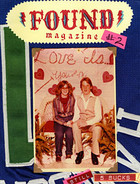
I was overjoyed to find that someone else (many other people really) have the same fascination I do with found objects.  They have started a zine and a website called Found Magazine.  Found Magazine is free of advertising and is easy to find in Independent bookstores or art shops.  There are many editions featuring found notebooks, lists, recipes, photos, love notes, school reports, children's drawings, teacher evaluations, report cards, audio tapes, diaries, posters for lost dogs, dire warnings left on windshields.  Some funny, some sad, some bittersweet, some WTF!!

So check out the website and make a mental note that if you find something interesting with handwriting or photos or drawings you are encouraged to mail it in to the good people at Found magazine who may feature it as the find of the day.  If you are a story lover like I am these will all pique your curiosity.  I wish I had thought of this first!

Sunday, May 15, 2011

Blogs become Books

These days many of my early review selections are books by bloggers.  Someone starts a blog about a particlar topic, in this case diet and nutrition, and attracts a lot of followers and uses that poplarity to launch a book of the same name.  I am impressed.  This method of getting yourself published seems to level the playing field a bit and give me hope that its not just literary writers who get to have a piece of the publishing pie. 
To be fair, there was a lot of useful advice in this book regarding how to approach dieting and weight loss with the many temptations that bombard us day after day.  I also came across many good recipes that I will try:  pumpkin muffins and tomato zuchini fritatta to name just two.  So if you are looking for good low fat, high health recipes to try this is a good source (as her blog probably is too).


The only drawback to this book is that Ms Haupert's writing is not very interesting or engaging, and I had a hard time geting through each chapter.  I am not sure it was possible to make it more lively.  She spent a lot of time explaining her schedule each day and her calorie counts.  Some people might find this fascinating, but I found it dry.  (I am also a tad over weight so maybe she does have something!)

I do want to give her credit for inventing a life for herself that is interesting and varied and sings to exactly what she wants to do.  This I envy and admire.  I guess that is another good reason to read this book:  she gives good advice on living a creative life and breaking the mold from the standard 8-5 drudgery. 

I can offer this book to anyone who would like it.

Tuesday, May 10, 2011

Who is Professor X?

Professor X wrote this article for the Atlantic Monthly in 2008.  It caused a lot of controversy when it appeared.  He excoriates our culture for demanding that College be a prerequisite for most jobs, even those that do not seem to need such preparation.  From this article he wrote:  In the Basement of the Ivory Tower: Confessions of an Accidental Academic.

It was hidden in a bottom shelf of a bookstore in the parenting section which was kind of odd, but of course I was attracted to it as I am part of the Ivory Tower and have learned to both love and hate it over the years.

This book is an interesting interplay of his own memoir, why he chose to adjunct and what it does for his finances and his marriage; a social critique of the culture that has elevated a college education way beyond it's possible worth, and a writing primer.

I have to say, that the combination really worked for me.  I was fairly convinced about his argument that we are unnecessarily pushing college at the expense of huge amounts of debt and frustration, his own story was sweet and well written and who can't use advice on writing, even if from an anonymous author.

Professor X chose to remain anonymous because he loves his job and doesn't want to lose it.  He no longer needs the money, his marriage is fine, but he truly enjoys teaching even if his students are woefully unprepared.

I would really like to write this man as I have a few critiques about some of his assumptions about college education.  The easy avenue of email probably won't be open to me.  I'll have to write his publisher.  I have a copy of it if anyone would like to borrow it.

Thursday, May 5, 2011

The Dirty Life by Kristin Kimball

The most compelling memoirs are not about movie stars or teenagers who combat abuse, alcoholism or anorexia. They are really the ones where ordinary people do unusual things with their lives.  Things that we can picture doing ourselves.

Kristin Kimball lived life as a NYC writer. Lattes and Central Park and nice clothing.  On a story assignment, she met a farmer who took her breath away and in a short amount of time she gave up her lease on her Manhattan apartment and joined the man she would later marry in starting an organic farm in Northern New York near Lake Champlain.

The work is back breaking and she has little time for sleep or any of the activities that normally occupy her.  Her parents think she is a tad crazy, but by the last chapter she has agreed to have a wedding on the farm for 300 people and comes to a happy satisfaction with her crazy, dirty life.

Her partner is an optimist and always believes that people will come together to care for each other: that things will be given them and labor be donated.  Their new community proves to be an oasis of faith and love and neighborliness of which they participate in as well.  It is exciting to follow the story of how the farm and the CSA come together seed by seed, animal by animal. The climax of  the story is a big grand wedding and a small glimpse into the future of a new baby born at home under the watchful eye of their pigs and cows.

If you are interested in this simple life,  the farming life, a life transformed you will enjoy this book as much as I did.

Saturday, April 30, 2011

In Honor of National Poetry Month

I have been remiss this month in not mentioning that April is National Poetry Month.  I spent some time reading and writing poetry this month and I participated in National Poem in your Pocket Day which was April 14th by passing out a poem by Pat Schneider which I will post at the end.

I also wrote a villanelle for a friend who has terminal cancer.  I wrote the villanelle using lines from his caring bridge website where people expressed their love and heartbreak and memories.  This site and the sentiments it generated created so many wonderful lines that it prompted me to create a found poem for my friend which I mailed to him.  Here are a few stanzas:


From this day forward every morning
at some point between 7:00 - 8:00 a.m and 9:00 - 10:00 a.m.
I will hold you in my heart and thoughts.

Your openness to this most current process
The next stage in your life journey
Will take you from this day forward every morning

I don’t understand why the powers that be let nasty people walk this earth
and yet take away the beautiful people.
this thought I will hold in my heart and thoughts


I'd love to hear how you celebrated National Poetry Month?  Did you read poetry?  Write poetry? Share poetry?  Find poetry?  Here is the poem in your pocket that I promised.  Pat Schneider is a favorite of mine.

The Patience of Ordinary Things
It is a kind of love, is it not?
How the cup holds the tea,
How the chair stands sturdy and foursquare,
How the floor receives the bottoms of shoes
Or toes. How soles of feet know
Where they're supposed to be.
I've been thinking about the patience
Of ordinary things, how clothes
Wait respectfully in closets
And soap dries quietly in the dish,
And towels drink the wet
From the skin of the back.
And the lovely repetition of stairs.
And what is more generous than a window?
Monday, April 25, 2011

The Boy in the Moon by Ian Brown

A sweet, sad and ultimately very thought provoking memoir written by the father of a severely disabled boy.  Walker Brown has a genetic mutation resulting in a syndrome that only about 100 people on the planet have.  Walker cannot speak, does not eat food and is fed through a G tube, wears diapers and must wear protective gear as he constantly hits himself and beats his head into the wall.  He is very small for his age and cannot communicate through any discernible means.

Ian, his wife Johanna, and the older sister Hayley spend 13 years caring for Walker round the clock until the parents finally find a suitable group home for him.  Ian then embarks on a journey to discover what, if anything, his son's life means to him, to the community and to humanity.  Surely there must be some answer as to what his life means?

The author travels around Canada and the US meeting other families with children that have this syndrome. He travels to California to meet the geneticists who first confirmed this condition and understand how a mutation on a gene can occur to create the condition.  He goes to France to meet advocates for the disabled, philosophers of disability studies, and to visit communities of severely disabled.   He looks at his own heart and mind and reactions to people like Walker and he takes a cursory look at how the severely disabled have been treated in the Western world throughout history.

I was fascinated by the picture he painted of his life, his marriage and his unending love for his son.  He thoroughly examines all the ethics at work in studying genes that produce disabled humans, the ethics of how we treat the least of all in our care and the philosophies behind how to treat these children.  It was all wonderfully enlightening.  A fascinating look at people who we don't like looking at or even being around.

I am humbled by the questions Mr. Brown raises and by his own love for a child who most of society will always see as lesser. I really understood the love he described for his son, and his own interest and passion for helping and understanding the disabled helped me understand a bit more about being a parent.

If you are interested in my copy of this book please let me know and I will pass it along.

Thursday, April 21, 2011

A Secret Gift by Ted Gup

I learned two important things while reading this interesting story of a suitcase full of letters discovered in the author's mother's attic after her death.  The first thing is that we should all be careful not to throw away valuable letters, postcards, photos and newspaper clippings. Everything you save and hold is an entry into an amazing story like this one.

Ted Gup discovers a suitcase of letters written to a mysterious person named B. Virdot.  B. Virdot was his grandfather who had promised the residents of Canton some Christmas cheer during the depression.  The letters Mr. Gup found all asked for a small piece of that cheer.  They open a fascinating portal to the ethos and history of that very sad era in American history.

The letters and story made me curious about how my own grandparents from Erie, Pennsylvania made it through the depression and led me to the secong thing I learned which was my grandparents story of survival during the depression. My mother told me that they bought their small plot of land and the material to build a small house. They added rooms to the house as they could afford them. They also planted fruit trees and a large garden.  They had a chicken coop filled with chickens.  So even in the years when my grandfather only worked one day a week, they owned their home and land and had food on the table.  My mother noted that in addition to thier own kids (two) they also took care of two other family members.

What windows do you have on another era of time?  What secrets do your suitcases hold?  These are good questions to ask the people we love who lived through that time.  Mr. Gup did a great job of tracing the letters writers and their stories through the ages and learning about and understanding his own grandfather's story.